
| Country of origin: | Russia |
| Registries: | AKC, UKC, CKC |
| Occupation: | Versatile working dog |
| Size: | 26 to 30 in tall; 90 to 100 lbs |
| Longevity: | 10 to 12 years |
| Exercise: | Active |
| Training: | Moderate |
| Grooming: | Difficult |


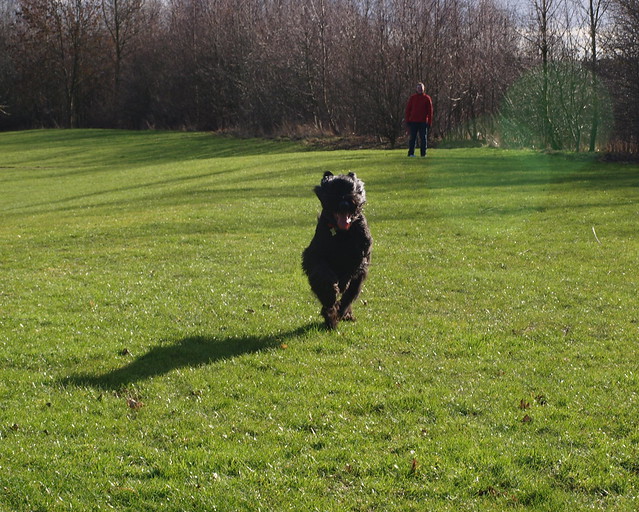


The Black Russian Terrier (Russian: Чёрный терьер), abbreviated as BRT, or Stalin’s dog (Sobaka Stalina) is a breed of dog, developed to serve as guard dog and police dog. It is rare outside the countries of the former Soviet Union but beginning to be formally recognized elsewhere: in July 2004, for instance, it became one of the AKC’s recognized breeds due to the efforts of Trident Kennels now located in Oregon.
Despite its name, the Black Russian Terrier is not a true terrier: it is believed that about twenty breeds were used in its development, including the Airedale, the Giant Schnauzer, the Rottweiler, the Newfoundland, the Caucasian Ovtcharka and the now extinct Moscow Water Dog.
History
The Black Russian terrier originated in Russia and would soon spread to many other countries. By the time the 1940s rolled around, their development began. They were created in the Red Star Kennel for military and guarding purposes up until the year 1957. Rottweilers, Airedale terriers, and schnauzers were the groundwork of the development of black Russian terriers. The standard was official in 1958 once civilians began getting their hands on these canines. They gained international attention in 1984 when people bought these black pups from military.
They were officially accepted by the AKC in 2004 upon spreading to Europe and North America. To this day, they are still used for sport, as guards, and of course as man’s loving best friend. They wanted to keep their working side intact when breeding began.
Personality
Just as any good working and guard dog should be, they are very alert but calm. They tend to be intimidating which is not always a bad thing when it came to their duties. They are powerful and dominating when it comes to outsiders or enemies. Their main purpose was usually to protect.
They also have a medium energy level so it helps when they get to work. They are confident and can be trained due to their intelligence level and responsive natures.
Traits
Black Russian Terriers state their coat colors in their name. Even though their double coat only comes in midnight shade of black, there can be one other acceptable variation. The hard, black coat sometimes has gray sprinkled throughout it. This creates a salt and pepper appearance. BRT dogs should not be considered soft-coated dogs. They typically have rough hair and although their undercoat is softer, it should never be considered silky or smooth.
The Black Russian terriers are typically very big dogs. They can range anywhere from 68 to 76 centimeters tall and 99 to 132 lbs heavy.
Handling
BRTs do not shed excessively which means grooming won’t be the hardest job in the world. They have a fairly long coat but it only requires regular grooming besides the face clipping. Their faces should be scissored in such a way that best shapes their facial hair, namely the mustache and beard. With any other dog breed, their nails should be checked and trimmed as necessary.
This breed of dogs require socialization when they are puppies to promote well-rounded behavior. Nurturing and love are also great to throw in there. Let them exercise plenty and give them a duty to fulfill. They will be extremely happy when these two things are put into motion. The best way to train them is with consistency and firmness that will keep them on track. Luckily they are easily trained and quick learners.
Health
The lifespan of Black Russian Terriers are usually around 10 to 12 years. They are prone to the typical of doggy health problems, such as hip and elbow dysplasia. Otherwise, they are typically healthy and have an average longevity. They simply want to live their lives serving a purpose and have the support and love of their family behind them.