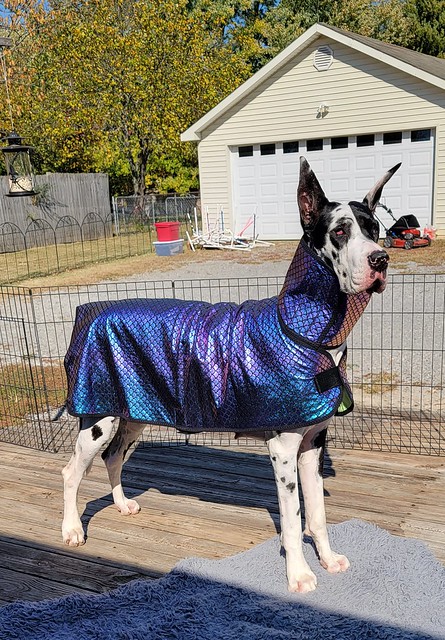
Great Dane

Country of origin: Germany
Registries: AKC, UKC, CKC
Occupation: Hunter, companion
Size: 28 to 32+ in; 125 to
180 lbs
Longevity: 8 to 10 years
Exercise: Moderate
Training: Moderate
Grooming: Easy
Colors: Fawn, black, blue, brindle, harlequin

This majestic and truly grand dog – the tallest of all dog breeds – was called the Grand Danois by the great French naturalist the Comte de Buffon, because he felt the strongest examples came from Denmark. It was not until 1880 that its other name, the Deutsche Dogge, was established at a dog show in Berlin. It is now Germany’s national dog. Like all mastiffs, the Great Dane’s origins are in Asia, and it is very likely its ancestors, the Alaunts (mentioned by Chaucer in the 1200s), were brought to Europe by the Alans, a Scythian tribe that originated in what is now Asian Russia. The Great Dane, as we know it today, was developed in the 1800s by crossing the regional northern European mastiffs with local greyhound stock. Great Danes are enormously gangly as pups and then develop into dignified and surprisingly gentle adults, some of whom love to sit on their owner’s laps. A heart condition, dilated cardiomyopathy (DCM), can be passed by unaffected females to half of their pups. Gene testing will eventually make it easier to reduce the risk of this fatal condition from developing. As one of the deepest-chested of all breeds, it is prone to life-threatening rotation of the stomach.

While adult Great Danes are typically moderate in their desire for frenetic activity, during their youth they can be enormously vigorous. A racing Great Dane like this one is wonderful to watch, but needs considerable space for manoeuvring. Care must be taken when exercising young dogs to prevent injury to dog and bystanders.

Advertisement

spot_img

Popular Questions

Can Dogs Eat Grass? Understanding the Safety and Reasons

As dog owners, we often find ourselves pondering our furry friends' peculiar behaviors. One such behavior is grass eating. Can dogs eat grass? Is...

Why Does My Dog Have Bad Breath? Understanding Halitosis

Bad breath, also known as halitosis, is a common issue among dogs. While it may seem like a minor concern, persistent bad breath in...

What is a Hotspot on a Dog? A Comprehensive Guide to Canine Hotspots

As dog owners, our primary concern is always the well-being of our furry companions. One common health issue that many dogs face is the...

Are Dogs Allergic to Gluten? A Comprehensive Look into Canine Nutrition

The gluten-free trend has become increasingly popular among humans as more people are diagnosed with gluten sensitivities or celiac disease. However, pet owners may...

Cushing’s Disease in Dogs

Hyperadrenocorticism, also know as Cushing’s disease, is a disease that can be very tricky to diagnose at first since it mainly occurs in older...

Autoimmune Disorders in Dogs: Causes, Symptoms, & Treatment

Autoimmune disorders are a group of conditions in which the immune system mistakenly attacks the body's own cells and tissues. These disorders can affect...

Fever in dogs

Fever also known as pyrexia is defined as a higher than a normal body temperature. This normal body temperature is common to all animals...

Diabetes in Dogs

Diabetes is a common disease in humans and is common enough in dogs too, so much so that about 1 in 500 dogs suffer...

Patellar Luxation in Dogs: Causes, Symptoms, and Treatment Options

Patellar luxation, also known as a dislocated kneecap, is a common orthopedic issue in dogs. This condition can cause discomfort, lameness, and may even...

Cataracts in Dogs

Cataracts in dogs are characterized by a cloudiness that forms in a clear sac that contains the lens of the dog’s eye. If cataracts...

Rabies in dogs

Rabies is one of the most dreaded diseases encountered by a pet owner and with good reason. It is a mostly fatal viral...

Stomach Bloating in Dogs: Causes, Symptoms, & Treatment

Stomach bloating in dogs is a common issue that can cause discomfort and, in some cases, pose serious health risks. In this article, we...

Eye Problems in Dogs: Causes, Symptoms, and Treatment Options

Eye problems in dogs are relatively common and can range from mild to severe. As a responsible dog owner, it is crucial to be...
Previous article
Next article