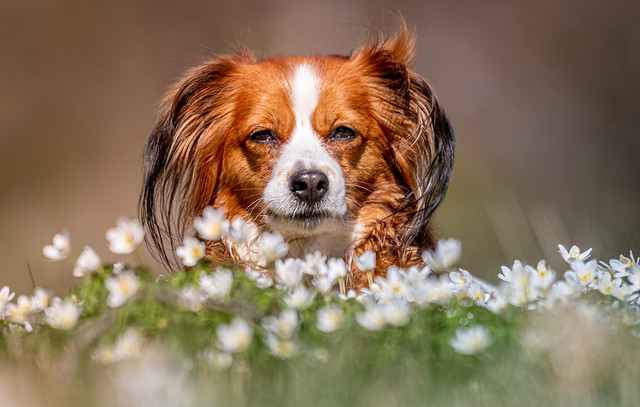
Kooikerhondje

Country of Origin: Netherlands
Registries: DKC, FCI, KCF, KCC, UKC, ARBA, KCUSA, DKC, KCGB, APRI, ACR, DRA, NAPR, AKC/FSS
Breed Group: FCI: Group 8 Section 2 #314, AKC: Sporting (FSS), KC (UK): Gundog, UKC : Gun Dog
Occupation: Sports dog, duck hunting and tolling
Size: Height:35 to 40 cm (14 to 16 inches)                         Weight: 9-11 kilograms (20 to 24 lbs)
Longevity; 12–14 years
Exercise: Daily long walk or jog
Training: Lots of socialization and play
Grooming: Moderate
Colors: Red & White

Kooikerhondje dog breed was developed in the 16th century in Netherlands. This was a tolling dog breed, used to lure and drive ducks into specific cages with traps, called “kooien” where the “kooiker” (hunter) was able to easily catch the prey. Dogs used by those hunters were called “Kooiker’s hondjes”, so this is from where they got their name. In translation, this means – Kooiker’s dogs.

During the World War II this breed almost got extinct. The truth is that Baroness van Hardenbroek van Ammerstol rescued the breed. In that time, this breed was officially recognized only by the Raad van Beheer, the Dutch Kennel Club, in 1971. Kooikerhondje dogs are still unknown in USA and Canada, even though they have been accepted into the UKC and ARBA.

In January 2013, the Kennel Club decided to re-classify the Kooikerhondje from the Gundog group to the Utility group. This will be effective from January 2014. Also, it is important to note that some breeders believe Kooikerhondje dogs might played a huge part in the development of the Nova Scotia Duck-Tolling Retriever.

The Kooikerhondje dogs are tall around 15 inches. They have a square body structure. However, depending on their gender, these dogs usually don’t weight more than 24 lbs. The Kooikerhondje dogs have medium long hanging ears, set very closely to the head. Their tail is long and furry.

This dog breed also has a waterproof medium length coat that can be very easily cleaned. Their bicolored and shiny coats can take even up to 2 years to mature. Their coat is medium long, and can be slightly wavy or simply straight.

The Kooikerhondje dogs are very good natured, cheerful and friendly. They are also intelligent and well behaved dogs, always on alert. They love to please their owners and are able to adapt to different situations very quickly. Even though they are not very trustworthy towards strangers, however once they get to know someone, they will trust that person until the rest of their life.

Advertisement

spot_img

Popular Questions

Can Dogs Eat Grass? Understanding the Safety and Reasons

As dog owners, we often find ourselves pondering our furry friends' peculiar behaviors. One such behavior is grass eating. Can dogs eat grass? Is...

Why Does My Dog Have Bad Breath? Understanding Halitosis

Bad breath, also known as halitosis, is a common issue among dogs. While it may seem like a minor concern, persistent bad breath in...

What is a Hotspot on a Dog? A Comprehensive Guide to Canine Hotspots

As dog owners, our primary concern is always the well-being of our furry companions. One common health issue that many dogs face is the...

Are Dogs Allergic to Gluten? A Comprehensive Look into Canine Nutrition

The gluten-free trend has become increasingly popular among humans as more people are diagnosed with gluten sensitivities or celiac disease. However, pet owners may...

Fever in dogs

Fever also known as pyrexia is defined as a higher than a normal body temperature. This normal body temperature is common to all animals...

Dental Issues in Dogs: Causes, Symptoms, and Treatments

Dental issues are common in dogs and can lead to a variety of health problems if left untreated. In this comprehensive guide, we will...

Cushing’s Disease in Dogs

Hyperadrenocorticism, also know as Cushing’s disease, is a disease that can be very tricky to diagnose at first since it mainly occurs in older...

Cancer in Dogs: Types, Symptoms, and Treatment Options

Cancer is a disease that affects not only humans but also our beloved canine companions. It is the leading cause of death in dogs...

Autoimmune Disorders in Dogs: Causes, Symptoms, & Treatment

Autoimmune disorders are a group of conditions in which the immune system mistakenly attacks the body's own cells and tissues. These disorders can affect...

Hair loss in dogs

Alopecia or hair loss is common to dogs and may vary from partial to complete hair loss. It may occur gradually or may happen...

Stomach Bloating in Dogs: Causes, Symptoms, & Treatment

Stomach bloating in dogs is a common issue that can cause discomfort and, in some cases, pose serious health risks. In this article, we...

Skin Infections in Dogs: Types, Causes, Symptoms, and Treatments

Skin infections in dogs are a common and often frustrating issue for both pets and their owners. These infections can be caused by various...

Bloat (gastric torsion) in Dogs – Symptoms, Treatment, Prevention

Bloat, also referred to as gastric dilation volvulus (GDV) and gastric torsion, is a condition in which a dog’s stomach becomes distended, twists, or...
Previous article
Next article