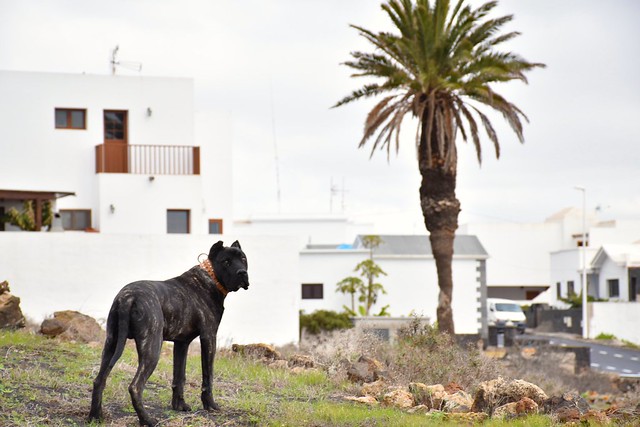
Perro de Presa Canario

Country of Origin: Canary Islands, Spain
Registries: APRI, DRA, NAPR, AKC/FSS
Breed Group: FCI: Group 2 Section 2.1 #346, AKC : Working (FSS), UKC: Guardian Dogs
Occupation: Working livestock, guard and companion
Size: Height: 55 – 65 cm (21 – 25 inches)                   Weight: 36 – 59 kg (80 – 130 lbs)
Longevity; 8–12 years
Exercise: Daily long walk.
Training: Early socialization and obedience
Grooming: Easy
Colors: Fawn and brindle

Perro de Presa Canario is a rare dog breed and was first time introduced to the world through a book written by anthropologist Dr. Carl Semencic. This dog was described as a large-size dog with a very muscular body.

These dogs have a broad head, and it is exactly the proper head of this dog breed that is the part of the breed standard. These dogs have cropped ears that stand erect. However, there are many countries where ear cropping is banned and in that case the ears are close fitting to the head.

Male Perro de Presa Canario have a standard height in the range of 23 to 26 inches with a minimum weight of 103 pounds and a maximum of 126 pounds. Females have a standard height between 22 to 25 inches with a minimum weight of 89 pounds and a maximum weight of 110 pounds.

Another interesting characteristic of this dog breed is the shape of their paws (cat foot) and their catlike movement. The body is mesomorphic which contributes to their feline movement.

The fur of Perro de Presa Canario is short with no undercoating. The fur comes in all shades of fawn and brindle.The black coat is allowed by the AKC-FSS, UKC and UPPCC standards, however it is not allowed by the FCI standards. These dogs should have a black mask that does not extend above the eyes. Also, it is important to note that the Perro de Presa Canario dogs are knownfor their minimal shedding.

As for their temperament, Perro de Presa Canario dogs can be aggressive toward other dogs and suspicious of strangers. During the puppy stage, these dogs are fun and playful, very loyal and fun dogs. Since they are pack dogs they gain aggression in numbers. Because of this, extreme early training is absolutely necessary.

Advertisement

spot_img

Popular Questions

Can Dogs Eat Grass? Understanding the Safety and Reasons

As dog owners, we often find ourselves pondering our furry friends' peculiar behaviors. One such behavior is grass eating. Can dogs eat grass? Is...

Why Does My Dog Have Bad Breath? Understanding Halitosis

Bad breath, also known as halitosis, is a common issue among dogs. While it may seem like a minor concern, persistent bad breath in...

What is a Hotspot on a Dog? A Comprehensive Guide to Canine Hotspots

As dog owners, our primary concern is always the well-being of our furry companions. One common health issue that many dogs face is the...

Are Dogs Allergic to Gluten? A Comprehensive Look into Canine Nutrition

The gluten-free trend has become increasingly popular among humans as more people are diagnosed with gluten sensitivities or celiac disease. However, pet owners may...

Bloat (gastric torsion) in Dogs – Symptoms, Treatment, Prevention

Bloat, also referred to as gastric dilation volvulus (GDV) and gastric torsion, is a condition in which a dog’s stomach becomes distended, twists, or...

Fever in dogs

Fever also known as pyrexia is defined as a higher than a normal body temperature. This normal body temperature is common to all animals...

Skin Infections in Dogs: Types, Causes, Symptoms, and Treatments

Skin infections in dogs are a common and often frustrating issue for both pets and their owners. These infections can be caused by various...

Elbow Dysplasia in Dogs: Diagnosing & Treating Joint Disorder

Elbow dysplasia is a common orthopedic condition affecting dogs, particularly large breeds. It can lead to chronic pain, decreased mobility, and a reduced quality...

Diarrhea in dogs

Diarrhea is the passage of frequent loose or watery stools. Dogs are susceptible to bouts of diarrhea from time to time. A single occurrence...

Hair loss in dogs

Alopecia or hair loss is common to dogs and may vary from partial to complete hair loss. It may occur gradually or may happen...

Patellar Luxation in Dogs: Causes, Symptoms, and Treatment Options

Patellar luxation, also known as a dislocated kneecap, is a common orthopedic issue in dogs. This condition can cause discomfort, lameness, and may even...

Cancer in Dogs: Types, Symptoms, and Treatment Options

Cancer is a disease that affects not only humans but also our beloved canine companions. It is the leading cause of death in dogs...

What is a Hotspot on a Dog? A Comprehensive Guide to Canine Hotspots

As dog owners, our primary concern is always the well-being of our furry companions. One common health issue that many dogs face is the...
Previous article
Next article