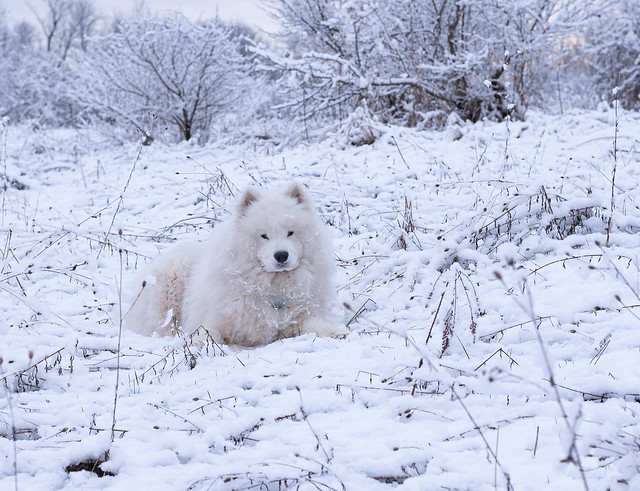
Samoyed

Country of origin: Russia
Registries: AKC, UKC, CKC
Occupation: Herder, hunter,
sled dog, companion
Size: 23–30kg (51–66lb),
46–56cm (18–22in)
Longevity: 11 to 13 years
Exercise: Daily aerobic exercise
Training: Easy to moderate
Grooming: Moderate; lots of
brushing
Colors: White, cream, white and biscuit,
silver tipped

This dog, also called the Samoyedskaya, accompanied the Samoyed people across the far north of Asia for generations as both a hunter and a herder of reindeer. First introduced to the West in 1889, it has made a smooth transition to the role of household companion and become a popular, firmly established breed due to its striking looks and engaging personality. This is a remarkably friendly and gentle breed, which according to the British standard “displays affection to all mankind”. This makes it an excellent family dog, but limits its usefulness as a guard. Obedience classes are still advisable, as Samoyeds can be stubborn, in their own dignified way.

Advertisement

spot_img

Popular Questions

Can Dogs Eat Grass? Understanding the Safety and Reasons

As dog owners, we often find ourselves pondering our furry friends' peculiar behaviors. One such behavior is grass eating. Can dogs eat grass? Is...

Why Does My Dog Have Bad Breath? Understanding Halitosis

Bad breath, also known as halitosis, is a common issue among dogs. While it may seem like a minor concern, persistent bad breath in...

What is a Hotspot on a Dog? A Comprehensive Guide to Canine Hotspots

As dog owners, our primary concern is always the well-being of our furry companions. One common health issue that many dogs face is the...

Are Dogs Allergic to Gluten? A Comprehensive Look into Canine Nutrition

The gluten-free trend has become increasingly popular among humans as more people are diagnosed with gluten sensitivities or celiac disease. However, pet owners may...

Osteochondritis Dissecans: Causes, Symptoms, & Treatment

Osteochondritis dissecans (OCD) is a joint disorder that affects both humans and animals, including dogs. This condition occurs when a piece of cartilage and...

Ear Infections in Dogs: Causes, Symptoms, & Treatment

Ear infections are a common health issue in dogs and can cause significant discomfort and pain. It is essential for pet owners to be...

Patellar Luxation in Dogs: Causes, Symptoms, and Treatment Options

Patellar luxation, also known as a dislocated kneecap, is a common orthopedic issue in dogs. This condition can cause discomfort, lameness, and may even...

Eye Problems in Dogs: Causes, Symptoms, and Treatment Options

Eye problems in dogs are relatively common and can range from mild to severe. As a responsible dog owner, it is crucial to be...

What is a Hotspot on a Dog? A Comprehensive Guide to Canine Hotspots

As dog owners, our primary concern is always the well-being of our furry companions. One common health issue that many dogs face is the...

Developmental Growth Disorders in Puppies

If your puppy is of a large or giant breed (those breeds that would weigh 55 pounds or more when fully grown), you should...

Brachycephalic Breeds

Brachycephalic dogs are those affected by brachycephalic respiratory syndrome. In Greek, “brachy” means “shortened” and “cephalic” means “head”. The shortened head of a dog...

Cataracts in Dogs

Cataracts in dogs are characterized by a cloudiness that forms in a clear sac that contains the lens of the dog’s eye. If cataracts...

Autoimmune Disorders in Dogs: Causes, Symptoms, & Treatment

Autoimmune disorders are a group of conditions in which the immune system mistakenly attacks the body's own cells and tissues. These disorders can affect...
Previous article
Next article