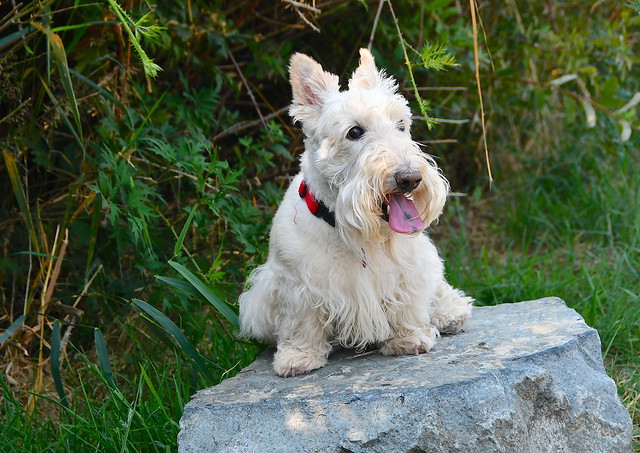
Scottish Terrier

Scottish Terrier

Country of origin: United Kingdom (Scotland)
Registries: AKC, UKC, CKC
Occupation: Vermin hunter,
companion
Size: 8.5–10.5kg (19–23lb),
25–28cm (10–11in
Longevity: 12 to 14 years
Exercise: Moderate
Training: Moderate
Grooming: Difficult
Colors: Wheaten, black, red-brindle,
black-brindle


The distinctive Scottish Terrier is a sturdy powerhouse of a dog with a thick, insulating double coat, bred to work outdoors and pursue small game underground. The breed developed in Aberdeen in the 19th century, probably from dogs from the Scottish Western Isles, and was also called the Aberdeen Terrier. Scotties have always been most popular in North America. The Scottish Terrier makes a quiet, reserved, slightly stubborn companion and a superb guard dog. Its gentlemanly image was perpetuated by its role in the 1955 Walt Disney film, Lady and the Tramp. While its classic image is as the black companion to the white Westie, Scottish Terriers come in a variety of colours.

While many people are familiar with president George W. Bush’s two Scotties, Barney and Miss Beazley, the 32nd US president, Franklin D. Roosevelt, also chose a Scottie, Fala, as his White House companion. Fala survived Roosevelt by seven years and was buried alongside him. A statue of the pair is featured in the Franklin Delano Roosevelt Memorial in Washington, DC.

Advertisement

spot_img

Popular Questions

Can Dogs Eat Grass? Understanding the Safety and Reasons

As dog owners, we often find ourselves pondering our furry friends' peculiar behaviors. One such behavior is grass eating. Can dogs eat grass? Is...

Why Does My Dog Have Bad Breath? Understanding Halitosis

Bad breath, also known as halitosis, is a common issue among dogs. While it may seem like a minor concern, persistent bad breath in...

What is a Hotspot on a Dog? A Comprehensive Guide to Canine Hotspots

As dog owners, our primary concern is always the well-being of our furry companions. One common health issue that many dogs face is the...

Are Dogs Allergic to Gluten? A Comprehensive Look into Canine Nutrition

The gluten-free trend has become increasingly popular among humans as more people are diagnosed with gluten sensitivities or celiac disease. However, pet owners may...

Elbow Dysplasia in Dogs: Diagnosing & Treating Joint Disorder

Elbow dysplasia is a common orthopedic condition affecting dogs, particularly large breeds. It can lead to chronic pain, decreased mobility, and a reduced quality...

Cataracts in Dogs

Cataracts in dogs are characterized by a cloudiness that forms in a clear sac that contains the lens of the dog’s eye. If cataracts...

Poisoning in dogs

Dogs by nature are inquisitive and curious. A great habit it is, when you are taking your dog out to walk. However, it works...

Autoimmune Disorders in Dogs: Causes, Symptoms, & Treatment

Autoimmune disorders are a group of conditions in which the immune system mistakenly attacks the body's own cells and tissues. These disorders can affect...

Hair loss in dogs

Alopecia or hair loss is common to dogs and may vary from partial to complete hair loss. It may occur gradually or may happen...

Kennel Cough in Dogs

Canine infectious tracheobronchitis or kennel cough as it is commonly known is not a serious condition which requires an immediate visit to the vet....

Brachycephalic Breeds

Brachycephalic dogs are those affected by brachycephalic respiratory syndrome. In Greek, “brachy” means “shortened” and “cephalic” means “head”. The shortened head of a dog...

Cancer in Dogs: Types, Symptoms, and Treatment Options

Cancer is a disease that affects not only humans but also our beloved canine companions. It is the leading cause of death in dogs...

Canine Distemper in dogs – Symptoms, Treatment, Prevention

If you are a dog owner, canine distemper should be one of your greatest fears. Canine distemper is a viral disease, which is contagious...
Previous article
Next article