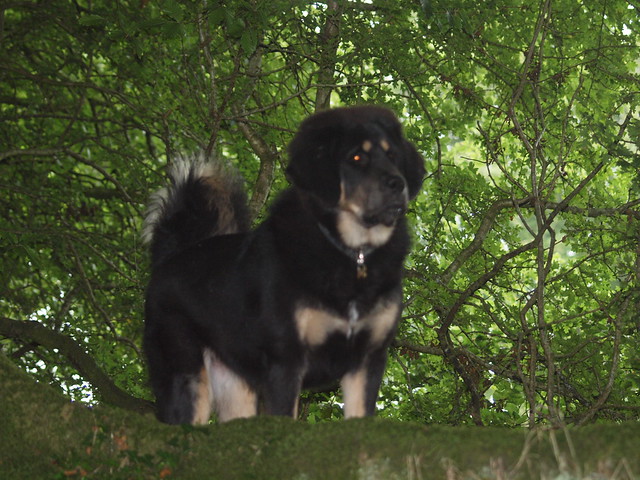
Tibetan Mastiff

Country of origin: Tibet
Registries: AKC FSS, UKC,
CKC
Occupation: Livestock
guardian
Size: 64–82kg (141–180lb),
61–71cm (24–28in)
Longevity: 10 to 12 years
Exercise: Moderate
Training: Challenge
Grooming: Moderate
Colors: Variety of colours

The mother of all mastiffs, this Tibetan dog was rescued from oblivion by British breeders in the late 1800s. Although its numbers remain small, it has been popular on European and North American dogshow circuits ever since. It is very likely that dogs similar to these, once used by Tibetan nomads to protect their homes and their flocks, provided the root stock for all of Asia’s and Europe’s giant livestock-guarding breeds. Over a century of selective breeding for show and companionship has resulted in a more easy-going temperament. Although this dog can be a little aloof, it makes a good family pet in either temperate or cold climates.

The Bearded Tibetan Mastiff, the Tibetan Kyi Apso, from the remote, high-plateau region of Mount Kailish, is a smaller, regional variation, half the size of the Tibetan Mastiff and with a wiry coat. Once used by Tibetan nomads to guard their sheep and camps, it retains its traditional abilities while making a self-reliant, engaging family dog. First seen in the West in 1994, it is still very rare outside Tibet.

Advertisement

spot_img

Popular Questions

Can Dogs Eat Grass? Understanding the Safety and Reasons

As dog owners, we often find ourselves pondering our furry friends' peculiar behaviors. One such behavior is grass eating. Can dogs eat grass? Is...

Why Does My Dog Have Bad Breath? Understanding Halitosis

Bad breath, also known as halitosis, is a common issue among dogs. While it may seem like a minor concern, persistent bad breath in...

What is a Hotspot on a Dog? A Comprehensive Guide to Canine Hotspots

As dog owners, our primary concern is always the well-being of our furry companions. One common health issue that many dogs face is the...

Are Dogs Allergic to Gluten? A Comprehensive Look into Canine Nutrition

The gluten-free trend has become increasingly popular among humans as more people are diagnosed with gluten sensitivities or celiac disease. However, pet owners may...

Elbow Dysplasia in Dogs: Diagnosing & Treating Joint Disorder

Elbow dysplasia is a common orthopedic condition affecting dogs, particularly large breeds. It can lead to chronic pain, decreased mobility, and a reduced quality...

Stomach Bloating in Dogs: Causes, Symptoms, & Treatment

Stomach bloating in dogs is a common issue that can cause discomfort and, in some cases, pose serious health risks. In this article, we...

Bloat (gastric torsion) in Dogs – Symptoms, Treatment, Prevention

Bloat, also referred to as gastric dilation volvulus (GDV) and gastric torsion, is a condition in which a dog’s stomach becomes distended, twists, or...

Diarrhea in dogs

Diarrhea is the passage of frequent loose or watery stools. Dogs are susceptible to bouts of diarrhea from time to time. A single occurrence...

Brachycephalic Breeds

Brachycephalic dogs are those affected by brachycephalic respiratory syndrome. In Greek, “brachy” means “shortened” and “cephalic” means “head”. The shortened head of a dog...

Dental Issues in Dogs: Causes, Symptoms, and Treatments

Dental issues are common in dogs and can lead to a variety of health problems if left untreated. In this comprehensive guide, we will...

Fever in dogs

Fever also known as pyrexia is defined as a higher than a normal body temperature. This normal body temperature is common to all animals...

Kennel Cough in Dogs

Canine infectious tracheobronchitis or kennel cough as it is commonly known is not a serious condition which requires an immediate visit to the vet....

Cataracts in Dogs

Cataracts in dogs are characterized by a cloudiness that forms in a clear sac that contains the lens of the dog’s eye. If cataracts...
Previous article
Next article