| Country of origin: | USA |
| Registries: | AKC, UKC, CKC |
| Occupation: | Companion, watchdog, performer |
| Size: | Toy: 9 to 12 in tall Mini: 12 to 15 in tall Standard: 15 to 19 in tall |
| Longevity: | 13 to 15 years |
| Exercise: | Vigorous daily exercise |
| Training: | Easy; hard to focus |
| Grooming: | Twice weekly brushing |


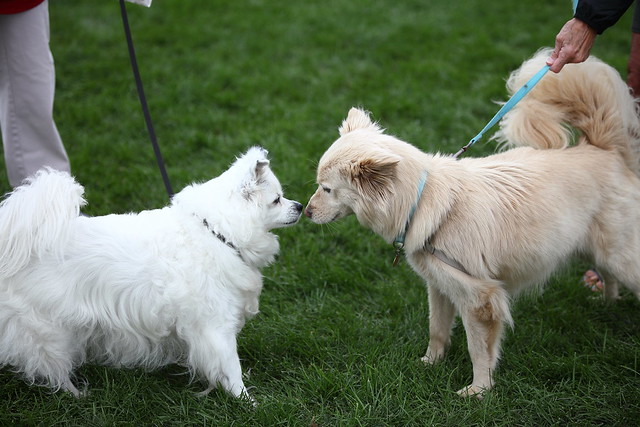


The American Eskimo Dog is a breed of companion dog originating in Germany. The American Eskimo is a member of the Spitz family. Despite its name and appearance, the American Eskimo dog is not from Alaska; the dog’s heritage is traced back to Northern Europe. The breed’s progenitors were German Spitz, but due to anti-German prejudice during the First World War, it was renamed “American Eskimo Dog”. Although modern American Eskimos have been exported as German Spitz Gross (or Mittel, depending on the dog’s height), the breed standards are actually significantly different. In addition to serving as a watchdog and companion, the American Eskimo dog also achieved a high degree of popularity in the 1930s and 1940s United States as a circus performer.
History
Nicknamed the “Eskie”, these dogs actually have no association with eskimos or their culture despite popular belief. Their origination actually started in Germany. The American Eskimo breed are thought to be descendents of European spitzes and Nordic breeds. They were first known as the German spitz but later changed. This was because of the elimination of anti-German bigotry during the war era in 1917.
Back in European regions, these non-sporting dogs were bred to be farm dogs and watch dogs. A couple decades later in the 1930s, these dogs evolved into trick dogs and performed in many circuses. Their popularity increased when crowds worldwide witnessed these snow white pups dancing to music and walking tightropes.
In 1994, the American Eskimo dog soon became apart of the AKC. In modern days, these dogs are loving family pets and competitors in dog competitions.
Personality
The American Eskimo dog has a well-rounded personality. They are often perky and playful but very intelligent. They can be hesitant of strangers and protective of their families. They are by no means aggressive though. Typically, this breed will not bite or attack despite its protective nature.
Eskies are great with children and are very excited to please their owners. They do anything they can do play with their loved ones and enjoy every minute of it.
Traits
American Eskimo dogs are limited to only two colors: a pure white or white and a biscuit color. They do however come in three different sizes: toy, miniature, and standard.
The toy-sized American Eskimo dogs are 9 to 12 inches tall and 6 to 10 lbs. The mini-sized dogs are 12 to 15 inches tall and weigh about 10 to 17 lbs. The standard Eskies are 15 to 20 inches tall and weigh anywhere from 18 lbs to 35 lbs.
These dogs are generally sought out by many for their beautiful and unique natures. They have a nordic-like face with black facial features that contrast against their snowy white double coat. Their ears are triangular and erect, and they sit with a fluffy tail that lies loosely on their back. Their hair is thick around their neck making them resemble lions.
Handling
Eskies are almost effortless to train and socialize. They are quick learners and very eager to make their owners happy. This means they’ll do anything they need to for the love of their human companions. They learn new commands by watching so they don’t need to repeat actions much before acing it. They do need to be raised with good crate training and socialization to avoid the development of poor behavior.
Also to avoid a negative conduct, these dogs needs a sufficient amount of mental and physical stimulation. Toys are very much recommended to keep these playful pups stimulated. If they do not get enough physical stimulus, they could become hyperactive or become overweight.
The American Eskimo is considered a heavy shedder and requires adequate grooming. Regular brushing is recommended. Nail trimming is also to ensure the good health of their feet.
Health
The American Eskimo dog is very healthy and are typically only known for having two serious health issues. The two health issues are progressive retinal atrophy and hip dysplasia. Both are usually late onset. Less seriously, tear ducts cause staining and allergies may occur. Otherwise, the life expectancy of this breed is up to 15 years.