| Country of origin: | USA |
| Registries: | AKC FSS, UKC |
| Occupation: | Gun dog, retriever |
| Size: | 15 to 18 in tall; 25 to 45 lbs |
| Longevity: | 13 to 15 years |
| Exercise: | Vigorous daily exercise |
| Training: | Easy |
| Grooming: | Difficult |


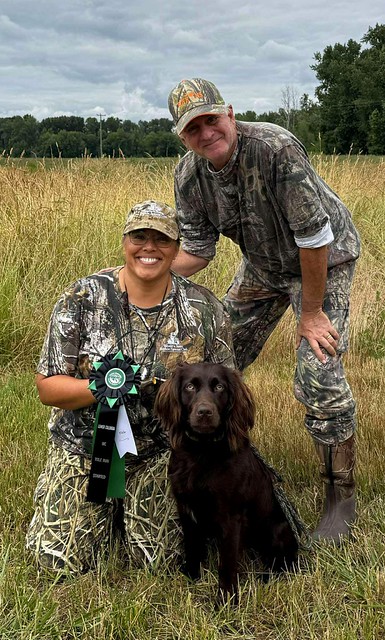


Discovered and further developed by South Carolina hunters for hunters in the 1900s, the Boykin Spaniel is a medium-sized breed of dog, a Spaniel bred for hunting wild turkeys and ducks in the Wateree River Swamp of South Carolina, in the United States. It is the state dog of South Carolina.
Breed name synonyms: ‘’The dog that does not rock the boat’’
HISTORY
The story of the Boykin Spaniels, starts just after the turn of the 20th century with a small, brown, stray Spaniel-type of dog named ,,Dumpy,,. The man behind the story was Mr. Alexander White of Spartanburg, South Carolina, who adopted the stray and noticed his great hunting abilities and wonderful bird sense. Later on he gave the dog to his hunting partner Mr. Boykin Whitaker. Together they evolved the Boykin Spaniel breed from this one dog, with crosses to American Water Spaniels, Springer Spaniels, Pointers and Chesapeake Bay Retrievers.
In 1985, Governor Richard Riley signed an act making the Boykin Spaniel South Carolina’s official state dog. Even today the Boykin Spaniel carries a unique set of credentials that no other breed of canine can honestly claim.
PERSONALITY
Boykin Spaniels are ,,busy dogs,, with a go-all-day stamina. They are enthusiastic and energetic in everything they do, from hunting to playing. Boykins are obedient and do not need to be told twice on what to do.
The typical Boykin is friendly, curious, gentle, loyal, willing worker, intelligent, easy to train and eager to please its owner. Although Boykin Spaniels are born hunters, they thrive on friendships, and enjoy the company of both children (except clumsy toddlers) and other dogs.
Boykins enjoy water and swimming and web-toed Boykins can swim like seals. They also have exceptionally good noses. Their active noses can make them prone to wandering.
TRAITS
Boykins have an alert, self-confident, attractive and intelligent expression. The hallmark of the Boykin Spaniel breed is its beautiful flat to slightly wavy solid-brown coat. The coat’s brown shades range from a rich liver to a luscious chocolate. A small amount of white on chest or toes is permitted. Boykin Spaniels have both an undercoat and an outer coat present. The outer coat is of medium length, while the undercoat is short and quite dense. Other unique characteristics include their yellow or amber eyes and large, feathery ears that hang close to the cheeks.
Boykin Spaniels are medium-sized dogs. Males stand 15.5-18’’ (39.5-46cm) at the shoulder, while females 14-16.5’’ (35-42.5cm). Females weight 25-35Ib (11-15kg) and males weigh 30-40Ib (14-18kg) .
HANDLING
The Boykin needs to be constantly reminded of what is expected of him and what is not. That is the main reason why this dog needs communicative owner, who is capable of displaying natural leadership. Training regimens should be based mostly on positive reinforcement and light corrections.
Training the Boykin Spaniel puppy should start the day it is brought home. Since Boykins are highly intelligent and eager to please, they are easy to train and capable of soaking every information and mastering every command.
If left alone, ignored and unattended, the creative and enthusiastic Boykin spaniel will find and think of ways to entertain himself.
HEALTH
The Boykin Spaniel is a relatively healthy breed, but just like any other breed it does suffer from a few common ailments. Boykin Spaniels are often concerned with some cardiovascular conditions such as pulmonic stenosis (which is the third most frequent cause of canine congenital heart disease) and some musculoskeletal conditions such as incomplete ossification of the humeral condyle (its usual age of presentation is 6 years) and hip dysplasia. The breed also has a high incidence of eye problems.
A few localized lines have some serious skin problems. There are no drug sensitivities reported in Boykin Spaniels.
Boykin Spaniels have an average lifespan of 14-16 years.