| Country of origin: | Great Britain |
| Registries: | AKC, UKC, CKC |
| Occupation: | Gun dog |
| Size: | 23 to 27 in tall; 60 to 80 lbs |
| Longevity: | 10 to 12 years |
| Exercise: | Vigorous daily exercise |
| Training: | Moderate |
| Grooming: | Moderate |
| Colors: | Liver, black |
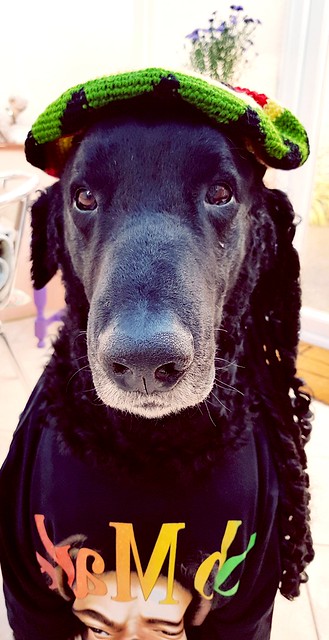


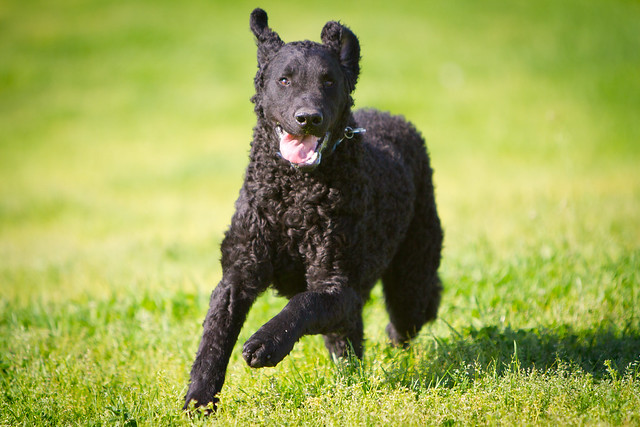
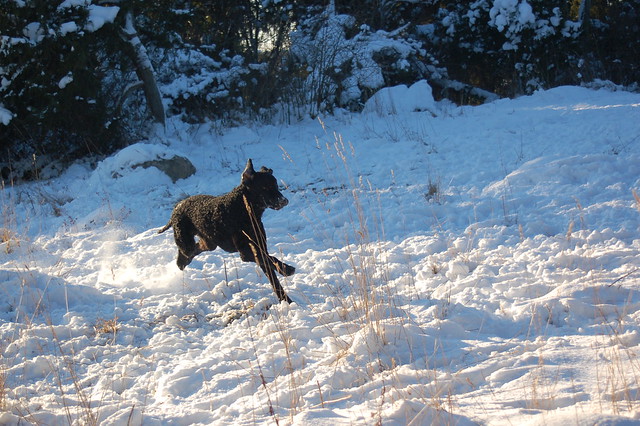


This is the oldest of the British retriever breeds, dating back to at least the start of the 19th century and once very popular for retrieving from water. Probably descended from the Lesser Newfoundland of British fishermen and the extinct English Water Spaniel, it has a perfect coat for a water dog, made up of tiny, tight, waterproof curls. Today it is the rarest of the retrievers, although it makes an alert, serious working dog and a calm, reliable companion. Hip dysplasia and eyelid problems are more common than average, and the coat can develop a distinctly doggy aroma.
Dog name synonyms: Curly
HISTORY
Although the Curly Coated Retriever was developed to retrieve birds from the icy and chilly waters of England in the 1800’s, there are historical evidence indicating that he was working as a team with man as early as 1490. However, the Curly Coated Retriever is known to be one of the oldest retrieving breeds.
The exact ancestry of this breed is unknown. It is thought that the Curly may have descended from from the now extinct English Water Spaniel, the smaller Newfoundland and the Irish Water Spaniel. The breed’s curls were introduced later on, after an outcross with Poodle.
After World War I, only five Curly Coated Retrievers were registered. Just after the breed began to recover, it was once again put on the brink of extinction, during World War II. Today Curlies are highly praised hunters and loving companions, but are still very rare.
PERSONALITY
Curly Coated Retrievers are self-confident, steadfast and proud. They are known to be determined and durable hunters. Curlies are very active and energetic dogs. On the field they are alert, biddable, responsive and focused. Because of their independent nature, Curlies may sometimes seem self-willed. However, their independence should not be confused with shyness or a lack of willingness to please.
Curly Coated Retrievers can be mischievous, but are very warm and loyal to their owners. Sometimes they can even be clownishly affectionate. They usually get on well with other dogs and other household animals such as cats. Curlies are sensitive, gentle and very good with children of all ages.
TRAITS
The Curly Coated Retriever is a large athletic dog, with distinctive curly coat, well-balanced body, deep chest and intelligent expression. Generally they appear massive, sturdy and strong, yet graceful and elegant. Curlies have teeth that meet in a scissors bite.
The hallmark of the breed is the coat. The Curly’s coat is actually a thick mass of small, tight, crisp curls that lay close to the skin and are water resilient. Only the face, hocks and front of the legs have smooth straight hair. The coat’s color must be solid black or liver. White patches are not desirable, but few white hairs can be accepted.
According to the standard, Curly males stand 25-27’’ (63.5-68.5cm) tall at the withers and weigh 70-80Ib (32-36kg). Females are 23-25’’ (58.5-63.5cm) tall and weigh 50-70Ib (24-32kg).
HANDLING
Curly Coated Retrivers are extremely intelligent dogs but training them can be challenging because their intelligence is rather instinctive. Sometimes they can be stubborn and proud of their stubbornness. Anyway, if positive reinforcement and treats are employed, Curlies can be trained. They are sensitive and do not respond well to harsh discipline and heavy-handed attitude. Although Curlies are not dominant by nature, firm boundaries must be set early on and the owner must assume the alpha position.
Curly Coated Retrievers must be properly socialized, because they are naturally suspicious of strangers. They get along with other dogs and children.
Curlies must be entertained at all times. If not, out of boredom, they can develop destructive behavior such as chewing and sticking in their mouths anything that would fit. They have a tendency of biting hands and sleeves.
HEALTH
Breed health concerns may include dermatological conditions (canine follicular dysplasia), ocular conditions (entropion – usually of the lower lids, ectropion, distichiasis, generalised progressive retinal atrophy, cataracts), gastrointestinal conditions (gastric dilatation and volvulus), musculoskeletal conditions (hip dysplasia, elbow dysplasia) and neurological conditions (seizures).
The average lifespan of a Curly-Coated Retriever is between 8 and 12 years.