
| Country of origin: | Germany |
| Registries: | AKC, UKC, CKC |
| Occupation: | Hunter, companion |
| Size: | No height standards Mini: under 11 lbs Standard: 16 to 32 lbs |
| Longevity: | 12 to 14 years |
| Exercise: | Moderate |
| Training: | Challenge |
| Grooming: | Easy to moderate, depending on coat type |
| Colors: | Variety of colours |


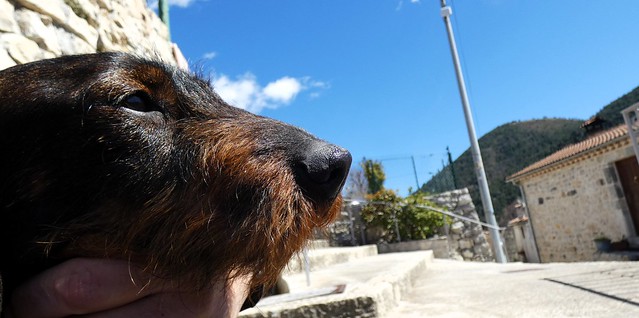


Dachshunds are true dwarfs. Their bone structure is normal with the exception of their long bones, which are dramatically shortened. Dachshund-like dogs are portrayed in an ancient Egyptian sculpture of a pharaoh seated with three dogs, but today’s opinionated individuals probably originated in the Middle Ages in what is now Germany. The American humorist E.B. White said his dachshunds were so insolent, they paused to have a smoke before deigning to follow him inside the house. The Smooth-haired Dachshund is the oldest variety. The Long-haired was probably developed by crossing Smoothhaired dogs with local short-legged spaniels, creating a very affectionate breed. The Wire-haired was developed by crossing Smooth-haired dogs with rough-coated local pinschers and then crossing these individuals with the somewhat goofy, avuncular, Scottish Dandie Dinmont. This is probably why the Wire-haired Dachshund has a slightly larger head size and a greatly diminished bloodlust. Show-standard dogs have short legs and deep chests that almost touch the ground. Working dogs have longer legs with considerable ground clearance for chests built to manoeuvre in rabbit burrows or badger setts. In Germany, where most dachshunds are bred to working-dog standards, they are classified according to chest size as Kaninchenteckel (Miniature), Zwergteckel (Dwarf), and Normalschlag (Standard). They are long-lived (see box), although their long backs and short legs predispose them to slipped discs, a condition that can cause complete posterior paralysis. Probably the most easily recognized of all breeds, and a favourite of advertisers, dachshunds remain consistently popular.
Dog name synonyms: Teckel & Wiener Dog
HISTORY
Although the Dachshund we now know, originated in Germany about 400 years ago, dogs of similar statute have been around for a very long time and are depicted in rock and tomb drawings in Egypt, South America and China. Among the Dachshund’s ancestors are the Braque, the Pinscher and the French Basset Hounds.
The name Dachshund is derived from the German words ,,Dach,, that means badger and ,,hund,, that means dog. As the name itself suggests, the Dachshund’s original purpose was hunting badgers. The fearless personality combined with elongated body, made it possible for the Dachshund to dig into badger burrows, go into the burrows and then fight the badger to the death if necessary.
Carefully sculpted through many years of breeding, the Dachshund is the only AKC-recognized breed that hunts both above and below ground.
PERSONALITY
Despite their size, Dachshunds are known for their courageous and brave nature. They are very self-confident and will take on animals much larger than themselves. Highly protective of their owners, Dachshunds can be suspicious and aggressive with other dogs and strangers. They can even be suspicious of approaching cars or bikes. They are alert little watchdogs, prone to excessive barking.
Dachshunds are bold, tenacious, and fearless to the point of madness. They are possessive of their stuff including toys, space and people and have been known to bite kids. All in all Dachshunds pack a whole lot of personality into a funny little body.
TRAITS
Dachshunds have long, muscular and low to ground bodies, short legs and long and tapered tails. They have confident and intelligent facial expression.
Dachshunds can have three types of coats – straight or wavy, silky and long; smooth, glossy and short or hard, thick and wiry. The Dachshund’s coat comes in an endless variety of colors and patterns.
When it comes to the Dachshund’s height at withers there is no written standard, but they should be under 9” (23cm) tall. The Miniature Dachshund weights less than 11lb (5kg) and the Standard weights 16-32lb (7-14.5kg).
HANDLING
Although tiny, Dachshunds believe they are in charge at all times. Bred for their strong independence and ability to make decisions on their own, Dachshunds can be hard to train. Unless they believe the activity or behavior was their own idea, they will become completely disinterested. If the Dachshund gets bored of certain activity, getting her attention back is almost always impossible.
When training this breed, one must have abundance of patience, firmness and treats. Dachshunds respond to harsh treatments with biting. The training sessions should be short and repeated several times a day. When raising a well-behaved Dachshund, proper socialization must be imposed from an early age.
HEALTH
The Dachshund breed is prone to several health issues, such as cardiovascular conditions (sick sinus syndrome, patent ductus arteriosus), dermatological conditions (alopecia areata, pododermatitis, Malassezia dermatitis, food hypersensitivity, pemphigus foliaceous, cCanine linear IgA dermatosis, oestrogen-responsive dermatosis, idiopathic sterile nodular panniculitis, colour-dilution alopecia, acanthosis nigricans, Ehler-Danlos syndrome), endocrine conditions (hypothyroidism, hyperadrenocorticism, diabetes mellitus), gastrointestinal conditions (haemorrhagic gastroenteritis), immunological conditions (undefined immunodeficiency syndrome, immune-mediated thrombocytopaenia), musculoskeletal conditions (inguinal or scrotal herniation, prognathia), neoplastic conditions (anal sac adenocarcinoma, mast cell tumours), neurological conditions (congenital deafness, intervertebral disc disease, atlantoaxial subluxation), ocular conditions (dermoid entropion , distichiasis, glaucoma, cataract), physiological conditions (hypochondroplasia), renal and urinary conditions (urethral sphincter mechanism incompetence, cystine urolithiasis), reproductive conditions (cryptorchidism) and respiratory conditions (pneumonia due to Pneumocystis carinii infection).
The average lifespan of the Dachshund is 12 to 14 years.