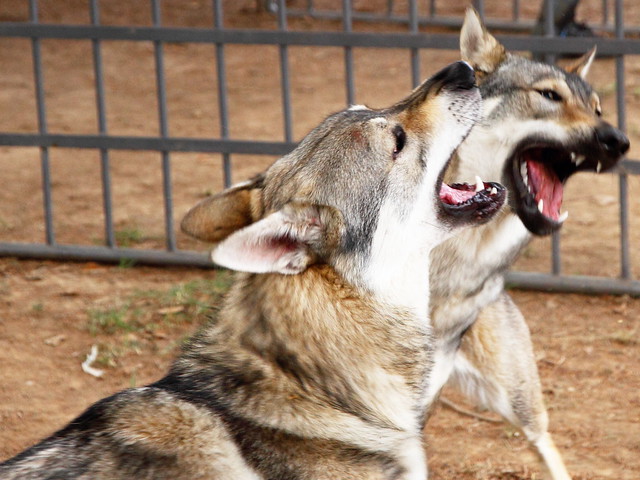
Czechoslovakian Vlcak

Country of Origin: Czechoslovakia
Registries: FCI, APRI, ACR, DRA, NAPR, AKC/FSS
Breed Group: FCI: Group 1 Section 1 #332, AKC: FSS
Occupation: Czechoslovak Special Forces commandos, used in search and rescue, schutzhund, tracking, herding, agility, obedience, hunting, and drafting.
Size: Height: Females – 61 to 68.5 cm (24 to 27 inches       Weight: 20 – 26 kg kg (44 – 54   lbs)
Longevity; 12 – 16 Years
Exercise: Daily long brisk walk
Training: extremely firm and patient hand in training,
Grooming: Average
Colors: Silver-gray, Grey, Yellow-gray

It was in the 60’s of the last century, when the Czechoslovakians decided to mix different dog breeds in order to get fantastic guards for their borders, and the two breeds that were used for this experiment were the Carpathian female wolf and the German shepherd.

As a result of the above mentioned mix, a new dog breed was made, unfortunately they didn’t become board guards as it was proven that this dog came up to be very timid and it also had some problems regarding the barking. As a matter of fact, these dogs bark is very rare and very weak. However, the species has gained superior performance and because of that it was added to the category of working dogs (such as for example Rottweiler, German Shepherd, Belgian Malinois, Dobermans, etc).

The status of the breed the Czechoslovakian Vlcak gained in the 80’s of the last century, and they spreaded more or less everywhere in the Europe. The highest percentage of this dog breed is in the Czech Republic, Poland, Russia, Slovakia, and Hungary and in the west in Italy.

The Czechoslovakian Vlcak is a breed that needs a lot of work and requires more patience – on one hand they are very hyperactive, and on the other hand they are very sensible. This is temperamental, very active and intelligent dog who acts quickly and without fear or courage. The Czechoslovakian Vlcak is very faithful to its owner. It is also very resistant to weather conditions and is universally usable.

His fur is straight, dense and adjacent to the body. The Czechoslovakian Vlcak’s winter and summer hair look very different. During the winter prevails a powerful undercoat with a cover that forms a thick coat over the entire body. Their color is yellow-gray to silver-gray with characteristic light mask, lighter hair on the bottom of the chest and the front of the chest.

Male Czechoslovakian Vlcak dogs can grow up to 65 centimeters and female dogs up to 60 cm. As far as their weight, the males can reach up to 26 kg and females up to 20 kg.

Advertisement

spot_img

Popular Questions

Can Dogs Eat Grass? Understanding the Safety and Reasons

As dog owners, we often find ourselves pondering our furry friends' peculiar behaviors. One such behavior is grass eating. Can dogs eat grass? Is...

Why Does My Dog Have Bad Breath? Understanding Halitosis

Bad breath, also known as halitosis, is a common issue among dogs. While it may seem like a minor concern, persistent bad breath in...

What is a Hotspot on a Dog? A Comprehensive Guide to Canine Hotspots

As dog owners, our primary concern is always the well-being of our furry companions. One common health issue that many dogs face is the...

Are Dogs Allergic to Gluten? A Comprehensive Look into Canine Nutrition

The gluten-free trend has become increasingly popular among humans as more people are diagnosed with gluten sensitivities or celiac disease. However, pet owners may...

Kennel Cough in Dogs

Canine infectious tracheobronchitis or kennel cough as it is commonly known is not a serious condition which requires an immediate visit to the vet....

Hip Dysplasia in Dogs: Causes, Symptoms, and Treatment Options

Hip dysplasia is a common skeletal condition affecting dogs, especially large and giant breeds. It occurs when the hip joint doesn't develop properly, resulting...

Canine Distemper in dogs – Symptoms, Treatment, Prevention

If you are a dog owner, canine distemper should be one of your greatest fears. Canine distemper is a viral disease, which is contagious...

Ear Infections in Dogs: Causes, Symptoms, & Treatment

Ear infections are a common health issue in dogs and can cause significant discomfort and pain. It is essential for pet owners to be...

Fever in dogs

Fever also known as pyrexia is defined as a higher than a normal body temperature. This normal body temperature is common to all animals...

Dental Issues in Dogs: Causes, Symptoms, and Treatments

Dental issues are common in dogs and can lead to a variety of health problems if left untreated. In this comprehensive guide, we will...

Bloat (gastric torsion) in Dogs – Symptoms, Treatment, Prevention

Bloat, also referred to as gastric dilation volvulus (GDV) and gastric torsion, is a condition in which a dog’s stomach becomes distended, twists, or...

Cataracts in Dogs

Cataracts in dogs are characterized by a cloudiness that forms in a clear sac that contains the lens of the dog’s eye. If cataracts...

What is a Hotspot on a Dog? A Comprehensive Guide to Canine Hotspots

As dog owners, our primary concern is always the well-being of our furry companions. One common health issue that many dogs face is the...
Previous article
Next article