Dandie Dinmont Terrier

Country of Origin: Scotland
Registries: CKC, FCI, AKC, UKC, KCGB, CKC, ANKC, NKC, NZKC, CET, APRI, ACR, DRA, NAPR
Breed Group: FCI: Group 3 Section 2 #168, AKC : Terrier, ANKC: Terriers Group, CKC: Terrier Group, KC: (UK) Terrier, NZKC: Terrier, UKC : Terrier
Occupation: great watchdogs
Size: Height:   20 to 28 cm (8–11 inches)       Weight: 8.2 to 11 kg (18 to 24 pounds)
Longevity; 11 – 13 Years
Exercise: Daily walk
Training: Needs to provide rules and limits to what it is and is not allowed to do
Grooming: Average. (Needs professional grooming)
Colors: Pepper or mustard

This small terrier is possibly a result of crossing the old Scottish terrier, Bedlington terriers and perhaps Otterhound.

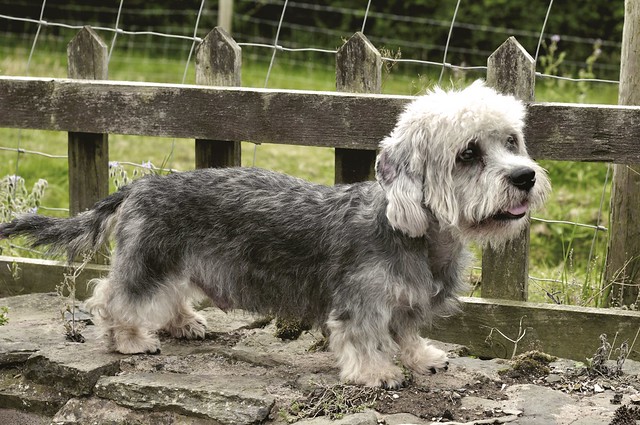
Dandy Dinmont Terrier is a sturdy, lively, dynamic and tireless small dog that is nowadays among the most respected dog’s for company in the UK. Dandy Dinmont Terrier has short legs, a pretty big head covered with silky hair, a protruding forehead and an elongated snout. His eyes are round and well apart and in dark hazel color. The ears are set low and falling along the cheeks.

The neck is well developed and the body is long and agile with muscular legs. The front legs are slightly shorter than the rear legs. The tail is curved and short, measuring from 20 to 25 cm. The hair consists of a mixture of sharp and soft hair, and can be either pepper colored ( from dark blue- gray to a light silver- gray ) with lighter or darker yellowish- brown legs or mustard color ( from light yellow to reddish – brown ) .

Dandy Dinmont Terrier is affectionate and intelligent dog full of energy and love towards its owner. It also has a strong protective line making him a good guard dog. But he can be very stubborn and unruly when he wants to.

Dandy Dinmont Terrier is great with small children. Even towards the strangers this dog is very friendly. If properly socialized it gets along well with other pets, such as for example cats and dogs, but rodents will hold their prey. Some male Dandy Dinmont terriers tend to show aggression towards other male dogs in the household. Therefore, it is not recommended that two Dandy Dinmont Terriers stay or live in the same household.

Dandy Dinmont Terrier is a dog that is perfectly happy with living in a flat. Even though it shreds very few, regular grooming of his hair is necessary.

Advertisement

spot_img

Popular Questions

Can Dogs Eat Grass? Understanding the Safety and Reasons

As dog owners, we often find ourselves pondering our furry friends' peculiar behaviors. One such behavior is grass eating. Can dogs eat grass? Is...

Why Does My Dog Have Bad Breath? Understanding Halitosis

Bad breath, also known as halitosis, is a common issue among dogs. While it may seem like a minor concern, persistent bad breath in...

What is a Hotspot on a Dog? A Comprehensive Guide to Canine Hotspots

As dog owners, our primary concern is always the well-being of our furry companions. One common health issue that many dogs face is the...

Are Dogs Allergic to Gluten? A Comprehensive Look into Canine Nutrition

The gluten-free trend has become increasingly popular among humans as more people are diagnosed with gluten sensitivities or celiac disease. However, pet owners may...

Poisoning in dogs

Dogs by nature are inquisitive and curious. A great habit it is, when you are taking your dog out to walk. However, it works...

Flea allergy dermatitis

Flea allergy dermatitis is an itchy skin disease that affects both dogs and cats. It is the most common skin disease found in dogs...

Fever in dogs

Fever also known as pyrexia is defined as a higher than a normal body temperature. This normal body temperature is common to all animals...

Osteochondritis Dissecans: Causes, Symptoms, & Treatment

Osteochondritis dissecans (OCD) is a joint disorder that affects both humans and animals, including dogs. This condition occurs when a piece of cartilage and...

Brachycephalic Breeds

Brachycephalic dogs are those affected by brachycephalic respiratory syndrome. In Greek, “brachy” means “shortened” and “cephalic” means “head”. The shortened head of a dog...

Cushing’s Disease in Dogs

Hyperadrenocorticism, also know as Cushing’s disease, is a disease that can be very tricky to diagnose at first since it mainly occurs in older...

Hair loss in dogs

Alopecia or hair loss is common to dogs and may vary from partial to complete hair loss. It may occur gradually or may happen...

Hypothyroidism in Dogs

If your dog seems sluggish, has gained weight, and doesn’t seem interested in being active, he or she may have an underactive thyroid. The thyroid...

Allergies in Dogs: Causes, Symptoms, and Treatments

Allergies are a common issue affecting many dogs, causing a range of symptoms that can impact their quality of life. In this comprehensive guide,...