| Country of origin: | Argentina |
| Registries: | AKC FSS, UKC |
| Occupation: | Hunter, guardian |
| Size: | 23.5 to 27 in tall; 85 to 100+ lbs |
| Longevity: | 10 to 15 years |
| Exercise: | Daily |
| Training: | Needs an experienced owner/trainer |
| Grooming: | Easy |
| Colors: | White |


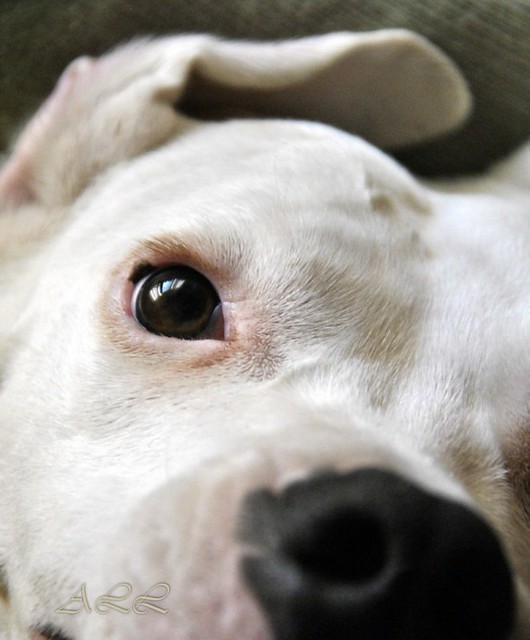



This breed is experiencing an international resurgence in popularity following the recent success of the film Bombón el Perro. Set in Patagonia, it tells the story of a red-eyed, crop-eared Argentinian Mastiff (Dogo Argentino) that gradually changes the life of his new owner for the better. This distinctive breed was developed by crossing Spanish fighting dogs and mastiffs, Boxers, Bulldogs, and oldstyle Bull Terriers to produce a puma and jaguar hunter. It instantly appealed to dog-fight organizers, and unfortunately it is still used to fight in South America and elsewhere. Its combative reputation has resulted in this breed being banned from a number of countries, including Britain. However, with early socializing to other dogs, and routine obedience training, the Argentinian Mastiff can make a loyal family companion for experienced dog handlers.
Dog name synonyms: Argentinean Mastiff
HISTORY
The Dogo Argentino, or the Argentinean Mastiff, as it is often called, is the canine equivalent of an armored tank. It is believed that the Dogo was created in the late 1920s, as a result of the efforts of two Argentinean brothers, Antonio and Agustin Martinez, who wanted a dog that would be brave and strong enough to hunt big game, but also manageable and fiercely protective of its owner. They crossed a native dog named the Cordoba (now extinct), with nine breeds including Spanish Mastiff, Irish Wolfhound, Bulldog, Great Pyrenees, Great Dane, Dogue de Bordeaux, Bull Terrier, Boxer and Pointer.
Later on, Dogo Argentinos were used used for military and police work, as guide dogs for the blind, for moose hunting, tracking and search and rescue missions.
Today because of their loyal personalities and tremendous hunting skills they are very popular dog breed worldwide. In their native Argentina, there is a statue erected in their honor.
PERSONALITY
Despite his intimidating appearance and toughness, the Dogo Argentino has a friendly personality and loves to be petted. The Dogo craves human affection, physical contact and closely-bonded relationship with its people. When it comes to protecting their owner, Dogos make excellent watch dogs, ready to fight, even to death the potential attacker. They can scare any intruder with their thunderous bark.
When in action, on the field Dogos are brave, determined and tireless hunters. They are intelligent, alert and athletic to their core.
TRAITS
Dogo Argentinos have massive and muscular bodies with a rectangular-like shape. Their heads are also massive, broad and convex, with short sturdy and square muzzles, strong jaws and high and widely set ears. Dogos have intelligent and powerful expressions. Overall the Dogo Argentino’s look combines power and elegance and is often described to have feline grace.
Dogo Argentionos have short, thick, smooth, glossy and pure white coat. The hair is stiff and relatively coarse. Although not preferable, darker skin pigmentation through the coat are acceptable. Dark black marking around one of the eyes, is also an acceptable trait.
The Dogo Argentino’s weight is 80-100Ib (36-45kg) and their height is 24-27’’ (60-69cm).
HANDLING
Created to be a pack hunting dog, the obedience trait was carefully bred in the Dogo Argentino. Therefore they are very responsive to training efforts, especially if the training sessions are fun. Dogos are at their best behavior when treated as part of the family but they must always know their exact place in the pack. They need to be handled with firm but loving leadership. If not dealt with proper leadership the Dogo Argentino can be a handful mess.
If the Dogo Argentino does not receive the proper amount of attention and training, it can turn to destructive behavior. Adult Dogo Argentinos can act aggressively with other dogs, but only if previously provoked. When properly socialized and raised together they can learn to get along with other dogs and smaller pets.
HEALTH
The Dogo is a fairly healthy breed, with a typical life span of between 9 and 12 years. Breed health concerns may include musculoskeletal conditions (hip dysplasia, elbow dysplasia, osteochondritis and panosteitis) and skin conditions (allergies, chronic bacterial skin infections followed by pyoderma and demodectic mange).
Because it is a deep-chested breed, the Dogo Argentino is very prone to gastric dilatation and volvulus. Another genetically predetermined health issue is the congenital deafness, which can be unilateral or bilateral. In Dogo Argentinos there is a high incidence of eyelid abnormalities such as entropion and ectropion.