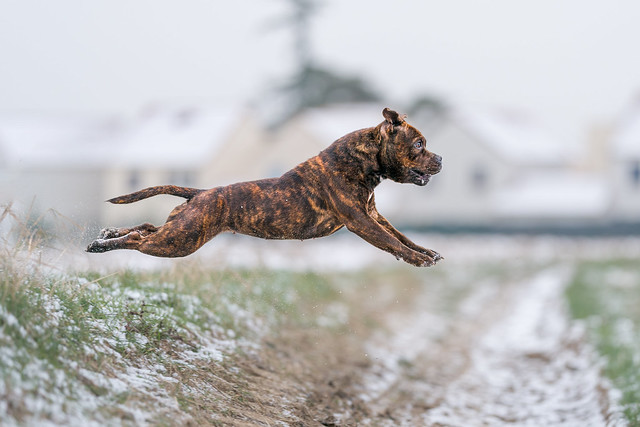
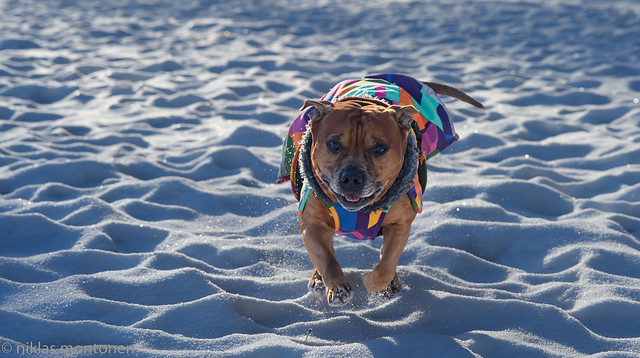
Staffordshire Bull Terrier

Country of origin: United Kingdom (England)
Registries: AKC, UKC, CKC
Occupation: Companion
Size: 11–17kg (24–37lb),
36–41cm (14–16in)
Longevity: 12 to 14 years
Exercise: Vigorous daily
exercise
Training: Moderate
Grooming: Easy
Colors: All colours except liver,
with or without white

To own a Staffie is to have two dogs for the price of one. Most of the time you will enjoy the company of a genial, affectionate, playful character who is the most loyal and devoted family member imaginable. Should another dog appear, however, you may be faced with a ferocious throwback to pit-fighting days, determined to destroy its opponent at any cost. As bull-baiting declined in the 17th century, breeders crossed terriers with bull-baiters, whose faces were too short for fighting other dogs. This created a range of bull terriers that would fight each other, until this “sport” too was outlawed in Britain and other countries in 1835. Breeders worked to save their favourites, and the Staffordshire Bull Terrier was recognized and shown as a distinct breed in 1935. Their fighting history still shows in their dual personality and also in their powerful, muscular build. Caesarian births are often needed and sunburn is a hazard in sunny climates. Skin allergies are not uncommon.

Advertisement

spot_img

Popular Questions

Can Dogs Eat Grass? Understanding the Safety and Reasons

As dog owners, we often find ourselves pondering our furry friends' peculiar behaviors. One such behavior is grass eating. Can dogs eat grass? Is...

Why Does My Dog Have Bad Breath? Understanding Halitosis

Bad breath, also known as halitosis, is a common issue among dogs. While it may seem like a minor concern, persistent bad breath in...

What is a Hotspot on a Dog? A Comprehensive Guide to Canine Hotspots

As dog owners, our primary concern is always the well-being of our furry companions. One common health issue that many dogs face is the...

Are Dogs Allergic to Gluten? A Comprehensive Look into Canine Nutrition

The gluten-free trend has become increasingly popular among humans as more people are diagnosed with gluten sensitivities or celiac disease. However, pet owners may...

Dental Issues in Dogs: Causes, Symptoms, and Treatments

Dental issues are common in dogs and can lead to a variety of health problems if left untreated. In this comprehensive guide, we will...

Hip Dysplasia in Dogs: Causes, Symptoms, and Treatment Options

Hip dysplasia is a common skeletal condition affecting dogs, especially large and giant breeds. It occurs when the hip joint doesn't develop properly, resulting...

Developmental Growth Disorders in Puppies

If your puppy is of a large or giant breed (those breeds that would weigh 55 pounds or more when fully grown), you should...

Canine Distemper in dogs – Symptoms, Treatment, Prevention

If you are a dog owner, canine distemper should be one of your greatest fears. Canine distemper is a viral disease, which is contagious...

Ear Infections in Dogs: Causes, Symptoms, & Treatment

Ear infections are a common health issue in dogs and can cause significant discomfort and pain. It is essential for pet owners to be...

Rabies in dogs

Rabies is one of the most dreaded diseases encountered by a pet owner and with good reason. It is a mostly fatal viral...

Autoimmune Disorders in Dogs: Causes, Symptoms, & Treatment

Autoimmune disorders are a group of conditions in which the immune system mistakenly attacks the body's own cells and tissues. These disorders can affect...

Patellar Luxation in Dogs: Causes, Symptoms, and Treatment Options

Patellar luxation, also known as a dislocated kneecap, is a common orthopedic issue in dogs. This condition can cause discomfort, lameness, and may even...

Flea allergy dermatitis

Flea allergy dermatitis is an itchy skin disease that affects both dogs and cats. It is the most common skin disease found in dogs...
Previous article
Next article