
| Country of origin: | Great Britain |
| Registries: | AKC, UKC, CKC |
| Occupation: | Pack hunter |
| Size: | Under 13 in tall and between 13 and 15 in; 15 to 30 lbs |
| Longevity: | 14 to 15 years |
| Exercise: | Moderate to vigorous |
| Training: | Challenge |
| Grooming: | Easy |










This most recently developed of all modern French hounds was created at the beginning of the 20th century, by crossing the Beagle or Beagle Harrier with medium-sized, short-haired Poitevins and Porcelaines. Its first standard was written less than 30 years ago. It was once called the Petit Anglo-Français, but as it is not related to the large Anglo- Français or Français hounds (see p.174), its name was changed to explain that it is a scent hound that works on the “little chase”.
History
The beagle started falling under a breed category in the 1800s. Although the origination of this breed is a bit foggy, they began their establishment in the 1830s. A man named Phillip Honeywood in Essex founded the breed and took preventative measures to avoid extinction. The breed teetered on the brink of extinction during its infancy years.
Two clubs were founded in the 1890s to preserve the Beagle breed. These dogs were a popular breed among royalty which helped promote popularity. In 1902, the breed was definitely on more stable ground as far as extinction goes. Thanks to the clubs, more packs were circulating in the world.
The AKC accepted official recognition in 1885. At this time, there was actually a division in the breed by coat type. Rough coats and smooth coats determined which sub-class of Beagle they would be. Eventually though, the rough coat dog would become extinct, leaving its smooth coat counterpart to run and pounce around.
Personality
Beagles were bred to be hunting dogs for the retrieval of rabbits and hare. They have an incredibly strong sense of smell as any scent hound would. They are generally a well-rounded breed since they can also be great pets. There’s a reason so many people choose them as pets and as models for movies. Pop culture largely involves the Beagle breed.
Because of the overly friendly and gentle nature of Beagles, they are often popular housepets. They are great with children and other dogs as they are not aggressive. They tend to love strangers once they get to know them also. They have an even temperament and are very intelligent. They have to be if they’re going to hunt rabbits and stay focused.
Traits
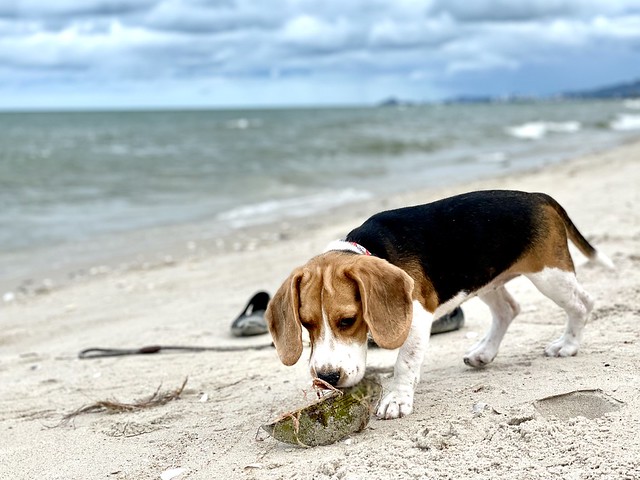
Beagles are small scent hounds that look like mini fox hounds. They stand between 13 and 16 inches tall. They weigh anywhere from 17 pounds to 35 pounds. Their ears are long but their muzzles are short. They have broad heads and can be tri-color of any variation. The most popular colors are black, brown, and white.
Handling
Although the Beagle is considered an intelligent breed, it is also very single-minded. This alone can make it hard to train them. Not to mention they tend to get distracted very easily due to their strong sense of smell. Their noses could potentially get them into trouble so it is necessary to keep them on a leash if you don’t want them wandering off. Despite these minute set-backs, their main goal is to please their owner and this alone helps when training.
Beagles love hard when it comes to their families so they can often have separation anxiety. That factor plus their tendency to get bored when left alone can equal unwanted consequences. Basically they’ll find ways to cope by tearing up a pillow or whatever they can get their paws on.
They do not require an extensive amount of exercise. Walks are still recommended to expend what energy they do have and for bonding time. Grooming isn’t extensive either as they are minimal shedders. Doggy odor and drool are not included in the package of a Beagle either. That alone explains why Beagles are great family dogs.
Health
Beagles aren’t known for many health problems. They are bred in such a way that they are healthy and do not suffer from inherited problems. Though it should be noted that they can end up with common health problems among dogs like hip dysplasia and hypothyroidism. They have a lifespan of 12 to 15 years despite any health problems they may rarely face.