| Country of origin: | Great Britain |
| Registries: | AKC, UKC, CKC |
| Occupation: | Hunter, companion |
| Size: | 15.5 to 16.5 in tall; 17 to 25 lbs |
| Longevity: | 10 to 12 years |
| Exercise: | Moderate |
| Training: | Moderate |
| Grooming: | Difficult |




History
Bedlington terriers are English dogs that first appeared in gypsy lore. They were used in Gentry by poachers to catch small game. After their status of “gypsy dog” was established, they got their first recognition of the breed in 1825.
A man by the name of Joseph Ainsley owned one of these dogs in the region of Bedlington of Northumberland. People enjoyed these unique dogs because they kept rodents and vermin at bay. It wasn’t until the 1870s that the dogs had their very own established club and dog shows. In 1886, the Bedlington Terrier became recognized by the AKC.
Personality
Bedlington Terriers have a very unique appearance but their personality is as normal as it comes. They are graceful and gentle just as lambs are considered to be. Do not mistake them for being weak though.
These dogs are very fast and alert. They can swim well and it is said they have a speed that could keep up with a horse. Their only downfall is that they tend to fight when approached with other dogs due to a strain of jealousy.
Traits
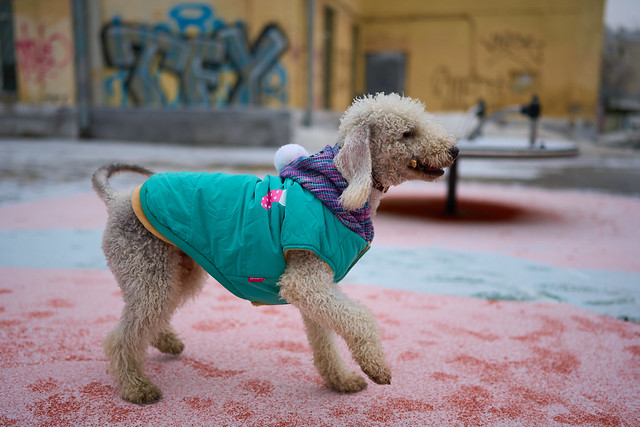
The utmost striking feature of the Bedlington Terrier is that they resemble lambs. Their outer appearance is truly unlike any dog you’d see waltzing down the street. They are of medium size and have a slender head. They can be anywhere from 15 inches tall to 17.5 inches. They weigh up to 23 lbs. The females are slightly smaller in height and weight. Their bodies are completely round and do not appear to stop at any one point.
Their coat is among the most unique trait of these dogs. They have a fleecy lamb-like coat and tassel ears. They are curly and feel like pocket-lint. You can almost compare them to a decorative pillow. They can only be about three variations of colors though. These colors are sandy, blue, and liver with tan markings.
Handling
Although these dogs can be fighters, they are also hard lovers when it comes to children and families. They may not want to be friendly when running around outside. They still have their tinge of jealousy so precaution should be exercised around other dogs. But the consensus and the AKC says they are gentle and fine companions for children.
With that said, they are easy to housebreak and adapt to homes. They do not require a substantial amount of exercise, only enough to let them have a little fun outside.
They have a curly hypoallergenic coat that does not shed a lot. It should be noted that their hair grows fairly quickly so they will require grooming. Not just anyone can groom without first learning how to due to their unique coats. Someone experienced must be able to groom their coats and maintain their tassel ears.
Health
Bedlington terriers are a generally healthy breed. They can be prone to eye problems and a disease called copper toxicosis but are still quite healthy. Copper toxicosis is when too much copper builds up in the liver. It can be a fatal disease and targets Bedlingtons more often than other breeds. Despite these health issues, they have a lifespan from 11 to 16 years.