| Country of origin: | France |
| Registries: | AKC, UKC, CKC |
| Occupation: | Gun dog |
| Size: | 17.5 to 20.5 in tall; 30 to 40 lbs |
| Longevity: | 12 to 14 years |
| Exercise: | Very active |
| Training: | Easy |
| Grooming: | Moderate |




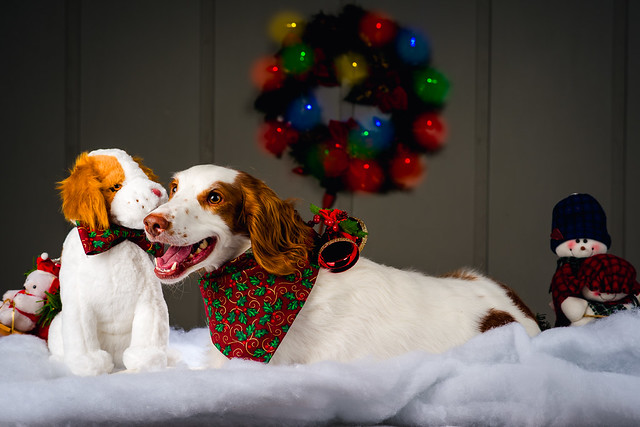


This breed, brought back from the brink of extinction in the 1900s by local breeder Arthur Enaud, is still the most popular gundog in its native France. It is also a favourite with hunters in North America. Despite its other names of Brittany Spaniel or Épagneul Breton, the reliable Brittany is primarily a pointer or setter in its behaviour, although it will also flush and retrieve from water.
Breed name synonyms: Epagnol Breton, Brittany Spaniel, American Brittany, Brittany Wiegref
HISTORY
The Brittany is a pointing breed who was created in France in the early 1700s. Its initial purpose was to be a versatile gundog. It is believed that the Brittany arose from Welsh Springer Spaniels and English Setters. After an outcross in the mid 1800s, the tailless and bobtail trait were introduced into the breed. Another belief is that the Brittany resulted of breeding an orange and white Setter with an unidentified indigenous French dog.
Even today the Brittany enjoys immense popularity among hunters. It has a superb nose and sense of smell, an ability to easily point out prey during hunt and an intense willingness to please. Brittanies are inexhaustible, extremely brave in the face of harsh conditions and very biddable.
PERSONALITY
Brittanies are quick, courageous and curious dogs. They love being active and are always on the lookout for birds or fun. Among the Brittany’s favorite activities are running, scouting, hunting and playing. Although some Brittanies can be mellow and stubborn, most of the Brittany members are quite active and soft.
Brittanies love kids and are very protecting of them. When properly raised they are friendly, playful and affectionate of every member of their pack, but can be wary of strangers.
Brittanies have a strong prey drive, but are capable of learning to get along with cats if they are raised together.
TRAITS
The Brittany is a compact and muscular dog of medium size and square built. Brittanies move in a strong, vigorous, energetic and quick way. Their expression is alert and eager, but at the same time soft and gentle.
The coat is dense and flat or wavy and the standard color patterns are liver and white or orange and white. The coat may also be roan but black is never allowed. The coat is specifically designed not to absorb nor hold water or dirt.
Brittanies weight 28-40lb (13-18kg) and their height at withers is 17.5-20.5” (44.5-52cm).
HANDLING
Brittanies are highly intelligent dogs and that makes them easily trainable. However harsh treatments will cause the Brittany to develop avoidance behaviors and can upset their sensitive nature. Therefore the best training technique is positive reinforcement. They should be treated gently and consistently, but firmly. It is very important to properly socialize the Brittany puppy, as they tend to be shy and timid. Exposing them to new people, surroundings and sounds is a must.
Even at early age Brittanies are capable of picking up hunting skills. They have excellent memory, and between hunting seasons, do not forget what they have previously learned.
Brittanies crave companionship and are known to develop separation anxiety. If left alone for a longer period of time, they become destructive, depressed and noisy.
HEALTH
Brittanys are generally healthy, but like all breeds, they are prone to certain health issues such as dermatological conditions (histoplasmosis, discoid lupus erythematosus, skin tumours), haematological conditions (deficiency of third component of complement) musculoskeletal conditions (hip dysplasia, incomplete ossification of the humeral condyle, spinal muscular atrophy), neoplastic conditions (liposarcoma), neurological conditions (cerebellar degeneration, spinal muscular atrophy, epilepsy), ocular conditions (lens luxation, generalised progressive retinal atrophy – GPRA, vitreal syneresis), renal and urinary conditions (familial renal disease – membranoproliferative glomerulonephritis), endocrine conditions (hypothyroidism) . There are no drug sensitivities reported in Brittanies.
The Brittany’s lifespan is estimated to be 12-14 years.