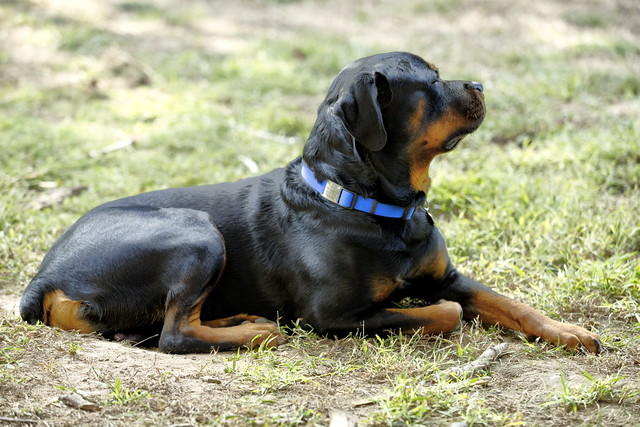
Rottweiler

Rottweiler

Country of origin: Germany
Registries: AKC, UKC, CKC
Occupation: Drover, police
dog, guardian, companion
Size: 41–50kg (90–110lb),
58–69cm (23–27in)
Longevity: 8 to 10 years
Exercise: Moderate
Training: Moderate; retains
training well
Grooming: Easy
Colors: Black and tan

Bred in Rottweil in southern Germany as a droving and cattle dog, the Rottweiler’s closest relative is probably the Great Swiss Mountain Dog. The two breeds share a variety of mental traits, including a relative ease of obedience training combined with a formidable protection instinct. It can be difficult to read a Rottweiler’s body language, and this breed can be unreliable as a consequence – the mood can change in a second from delight to anger, with the only visible sign being dilating eyes. High incidence of malignant bone cancer accounts for the foreshortened median life expectancy of only 9.8 years.

Advertisement

spot_img

Popular Questions

Can Dogs Eat Grass? Understanding the Safety and Reasons

As dog owners, we often find ourselves pondering our furry friends' peculiar behaviors. One such behavior is grass eating. Can dogs eat grass? Is...

Why Does My Dog Have Bad Breath? Understanding Halitosis

Bad breath, also known as halitosis, is a common issue among dogs. While it may seem like a minor concern, persistent bad breath in...

What is a Hotspot on a Dog? A Comprehensive Guide to Canine Hotspots

As dog owners, our primary concern is always the well-being of our furry companions. One common health issue that many dogs face is the...

Are Dogs Allergic to Gluten? A Comprehensive Look into Canine Nutrition

The gluten-free trend has become increasingly popular among humans as more people are diagnosed with gluten sensitivities or celiac disease. However, pet owners may...

Hair loss in dogs

Alopecia or hair loss is common to dogs and may vary from partial to complete hair loss. It may occur gradually or may happen...

Developmental Growth Disorders in Puppies

If your puppy is of a large or giant breed (those breeds that would weigh 55 pounds or more when fully grown), you should...

Dental Issues in Dogs: Causes, Symptoms, and Treatments

Dental issues are common in dogs and can lead to a variety of health problems if left untreated. In this comprehensive guide, we will...

Eye Problems in Dogs: Causes, Symptoms, and Treatment Options

Eye problems in dogs are relatively common and can range from mild to severe. As a responsible dog owner, it is crucial to be...

Cancer in Dogs: Types, Symptoms, and Treatment Options

Cancer is a disease that affects not only humans but also our beloved canine companions. It is the leading cause of death in dogs...

Diarrhea in dogs

Diarrhea is the passage of frequent loose or watery stools. Dogs are susceptible to bouts of diarrhea from time to time. A single occurrence...

Elbow Dysplasia in Dogs: Diagnosing & Treating Joint Disorder

Elbow dysplasia is a common orthopedic condition affecting dogs, particularly large breeds. It can lead to chronic pain, decreased mobility, and a reduced quality...

What is a Hotspot on a Dog? A Comprehensive Guide to Canine Hotspots

As dog owners, our primary concern is always the well-being of our furry companions. One common health issue that many dogs face is the...

Bloat (gastric torsion) in Dogs – Symptoms, Treatment, Prevention

Bloat, also referred to as gastric dilation volvulus (GDV) and gastric torsion, is a condition in which a dog’s stomach becomes distended, twists, or...
Previous article
Next article