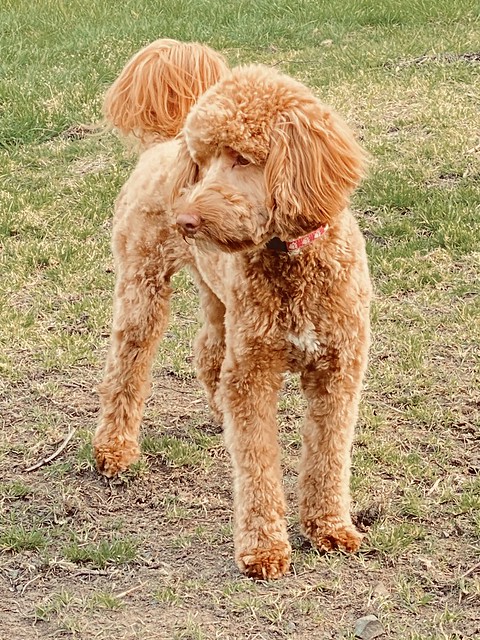
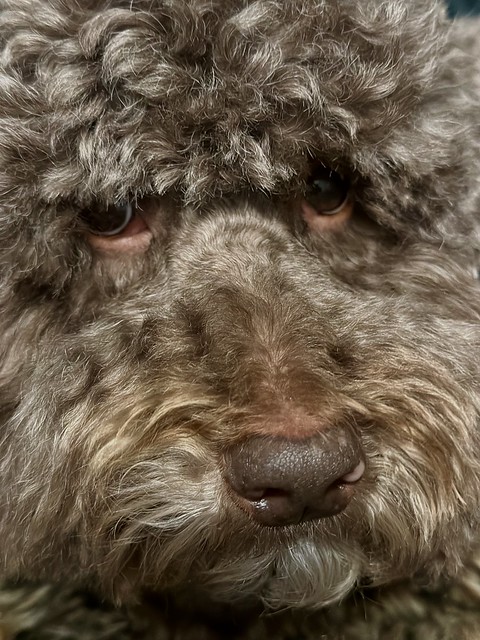
Labradoodle

Country of origin: Australia
Registries: Australian
Labradoodle Association,
Australian Labradoodle
Club of America
Occupation: Companion,
service dog
Size: Mini:14 to 16 in tall;
15 to 25 lbs
Medium: 17 to 20 in tall;
30 to 45 lbs
Standard: 21 to 24 in tall;
50 to 65 lbs
Longevity: 12 to 14 years
Exercise: Most are active, but
exercise needs vary
Training: Needs vary
Grooming: Moderate

The Labradoodle originated in Australia when a school for training dogs for the vision-impaired received a request for a dog from a woman whose husband was allergic to dogs. To try to suit her needs, a Labrador Retriever was crossed with a white Standard Poodle, and the offspring were called Labradoodles. After that beginning, a number of breeders became involved, but the crosses were not limited to the original two breeds. Poodles of all three sizes were used, along with Irish Water Spaniels and Curly Coated Retrievers, as well as American and English Cocker Spaniels. In the United States (and other countries), Labradoodles are still primarily crosses between Labrador Retrievers and Poodles, usually Standard Poodles.

Advertisement

spot_img

Popular Questions

Can Dogs Eat Grass? Understanding the Safety and Reasons

As dog owners, we often find ourselves pondering our furry friends' peculiar behaviors. One such behavior is grass eating. Can dogs eat grass? Is...

Why Does My Dog Have Bad Breath? Understanding Halitosis

Bad breath, also known as halitosis, is a common issue among dogs. While it may seem like a minor concern, persistent bad breath in...

What is a Hotspot on a Dog? A Comprehensive Guide to Canine Hotspots

As dog owners, our primary concern is always the well-being of our furry companions. One common health issue that many dogs face is the...

Are Dogs Allergic to Gluten? A Comprehensive Look into Canine Nutrition

The gluten-free trend has become increasingly popular among humans as more people are diagnosed with gluten sensitivities or celiac disease. However, pet owners may...

Hypothyroidism in Dogs

If your dog seems sluggish, has gained weight, and doesn’t seem interested in being active, he or she may have an underactive thyroid. The thyroid...

Cancer in Dogs: Types, Symptoms, and Treatment Options

Cancer is a disease that affects not only humans but also our beloved canine companions. It is the leading cause of death in dogs...

Bloat (gastric torsion) in Dogs – Symptoms, Treatment, Prevention

Bloat, also referred to as gastric dilation volvulus (GDV) and gastric torsion, is a condition in which a dog’s stomach becomes distended, twists, or...

Flea allergy dermatitis

Flea allergy dermatitis is an itchy skin disease that affects both dogs and cats. It is the most common skin disease found in dogs...

Cataracts in Dogs

Cataracts in dogs are characterized by a cloudiness that forms in a clear sac that contains the lens of the dog’s eye. If cataracts...

Kennel Cough in Dogs

Canine infectious tracheobronchitis or kennel cough as it is commonly known is not a serious condition which requires an immediate visit to the vet....

Ear Infections in Dogs: Causes, Symptoms, & Treatment

Ear infections are a common health issue in dogs and can cause significant discomfort and pain. It is essential for pet owners to be...

Allergies in Dogs: Causes, Symptoms, and Treatments

Allergies are a common issue affecting many dogs, causing a range of symptoms that can impact their quality of life. In this comprehensive guide,...

Patellar Luxation in Dogs: Causes, Symptoms, and Treatment Options

Patellar luxation, also known as a dislocated kneecap, is a common orthopedic issue in dogs. This condition can cause discomfort, lameness, and may even...
Previous article
Next article