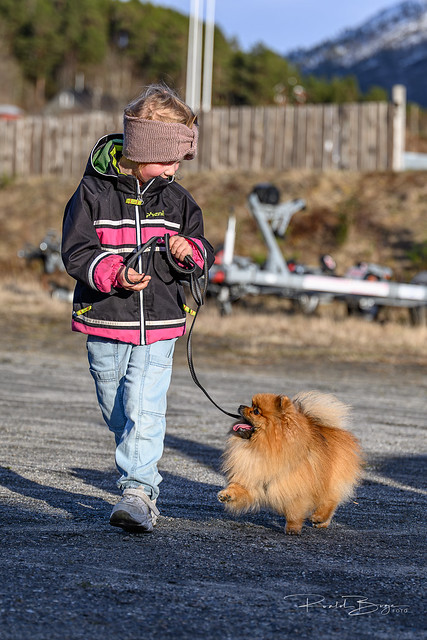
Pomeranian

Country of origin: Germany
Registries: AKC, UKC, CKC
Occupation: Companion,
performance sports
Size: 8 to 11 in tall; 3 to 7 lbs
Longevity: 14 to 16 years
Exercise: Moderate
Training: Challenge to
housetrain
Grooming: Moderate
Colors: Orange, white, cream, sable,
grey, blue, red-orange, brown, black

Bred in Germany, and popularized elsewhere by Queen Victoria, the Pomeranian, or Dwarf Spitz, is a miniaturized version of the German Spitz. In its mind, it is still that larger breed, so it will challenge other dogs, even large ones, and makes a noisy watchdog. Also called the Loulou, the Pomeranian is an active and vibrant companion, good for family and city life. The long, straight coat with ruff and plumed tail is the breed’s most distinctive characteristic. Originally, the coat colour most often seen was white, but by reducing size, breeders also brought out the brown-toned coat colours that are now most popular. Poms are surprisingly amenable to early obedience training.

By the 1870s the Pomeranian was routinely shown in Britain, and 30 years later was recognized in the United States. This calm individual, being sprayed to maintain its “powder-puff” looks, is about to enter the ring at a championship dog show in London in 1925. The breed’s luxurious coat takes three years to reach maturity.

Advertisement

spot_img

Popular Questions

Can Dogs Eat Grass? Understanding the Safety and Reasons

As dog owners, we often find ourselves pondering our furry friends' peculiar behaviors. One such behavior is grass eating. Can dogs eat grass? Is...

Why Does My Dog Have Bad Breath? Understanding Halitosis

Bad breath, also known as halitosis, is a common issue among dogs. While it may seem like a minor concern, persistent bad breath in...

What is a Hotspot on a Dog? A Comprehensive Guide to Canine Hotspots

As dog owners, our primary concern is always the well-being of our furry companions. One common health issue that many dogs face is the...

Are Dogs Allergic to Gluten? A Comprehensive Look into Canine Nutrition

The gluten-free trend has become increasingly popular among humans as more people are diagnosed with gluten sensitivities or celiac disease. However, pet owners may...

Canine Distemper in dogs – Symptoms, Treatment, Prevention

If you are a dog owner, canine distemper should be one of your greatest fears. Canine distemper is a viral disease, which is contagious...

What is a Hotspot on a Dog? A Comprehensive Guide to Canine Hotspots

As dog owners, our primary concern is always the well-being of our furry companions. One common health issue that many dogs face is the...

Diarrhea in dogs

Diarrhea is the passage of frequent loose or watery stools. Dogs are susceptible to bouts of diarrhea from time to time. A single occurrence...

Fever in dogs

Fever also known as pyrexia is defined as a higher than a normal body temperature. This normal body temperature is common to all animals...

Hip Dysplasia in Dogs: Causes, Symptoms, and Treatment Options

Hip dysplasia is a common skeletal condition affecting dogs, especially large and giant breeds. It occurs when the hip joint doesn't develop properly, resulting...

Elbow Dysplasia in Dogs: Diagnosing & Treating Joint Disorder

Elbow dysplasia is a common orthopedic condition affecting dogs, particularly large breeds. It can lead to chronic pain, decreased mobility, and a reduced quality...

Skin Infections in Dogs: Types, Causes, Symptoms, and Treatments

Skin infections in dogs are a common and often frustrating issue for both pets and their owners. These infections can be caused by various...

Flea allergy dermatitis

Flea allergy dermatitis is an itchy skin disease that affects both dogs and cats. It is the most common skin disease found in dogs...

Ear Infections in Dogs: Causes, Symptoms, & Treatment

Ear infections are a common health issue in dogs and can cause significant discomfort and pain. It is essential for pet owners to be...